
Spooky season is here: 40% off everything
The Halloween prep is ON. Door creaks... Footsteps approach... SCREA- Jokes, it’s only us coming thru with a hassle-free Halloween.
Kruk Garage Handcrafted Atelier

The five looks below aren't trend reports. They're descriptions of real ways women dress in autumn 2026 — the rhythm of a workday, the weight of a long walk, the decision to just wear the coat and be done with it. Each one is matched to a handmade leather bag from Kruk Garage, cut and stitched by hand in Ukraine from full-grain cowhide that will still be in use long after the season has changed. The bags in this article are not styled accessories. They are women's leather bags built to be worn, carried hard, and kept.
None of the pairings here are about matching exact shades or following a formula. They're about fit — between how a bag sits and how a day unfolds, between what leather does over time and what a woman is actually asking of the things she owns. Read through all five. One of them is probably already in your wardrobe, waiting for the right companion.
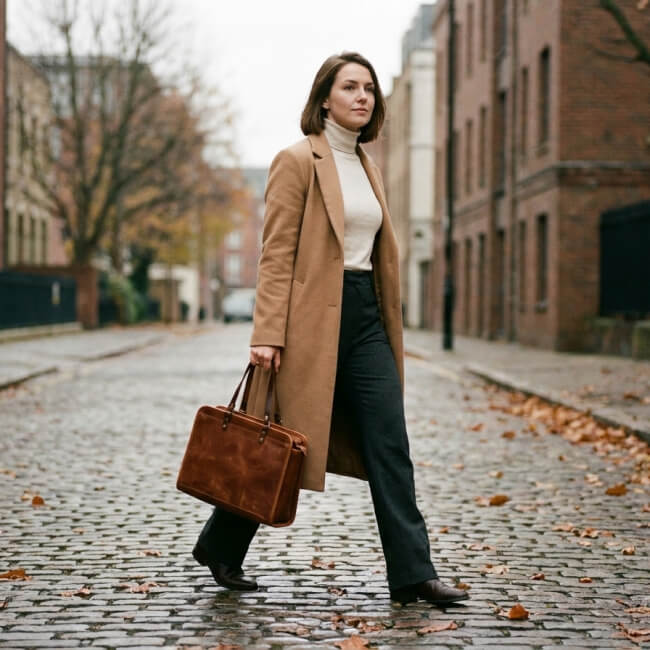 She doesn't wake up and make decisions about her wardrobe. The decisions were made a long time ago, in a gradual editing-down of everything that required thought in the morning. Dark, straight trousers. A fine-knit turtleneck in cream or stone. A long coat in a tone that sits somewhere between camel and slate. Ankle boots with a low block heel. The whole thing reads as effortless because it actually is, at this point — the result of years of buying less and choosing better. She's not performing minimalism. She just ran out of patience for anything that didn't work.
This kind of wardrobe asks a specific thing of a bag. It doesn't want to be surprised. A structured tote in cognac brown full-grain leather fits here the way a well-chosen word fits in a sentence — not because it draws attention, but because removing it would leave something noticeably missing. The New Tote has that quality. Its silhouette is clean without being severe, its proportions generous enough for a real working day without ever slouching into shapelessness. The cognac tone sits warmly against the cooler neutrals of a minimalist palette, providing contrast that doesn't announce itself.
What matters for this particular look is that the bag can stand on its own without decoration. There are no external pockets to bulk up the profile, no contrast piping, no logo hardware competing with the leather's surface. The handles have the right drop — close enough to carry at the elbow with intention, long enough to slip over a coat shoulder without bunching the fabric. The bag rides flat against the body and stays there. On a woman moving through a city in a long coat, that kind of stillness reads as composure.
The leather itself is worth considering here, because full-grain cowhide is not a neutral material — it is an active one. In the early weeks it is firm, a little stiff at the fold points, mildly resistant. Over months of daily carry it softens and darkens at the corners and edges, developing a patina that is specific to how this particular woman uses this particular bag. A minimalist wardrobe, where nothing is accidentally in the frame, turns that aging process into something meaningful: the bag doesn't look worn, it looks selected and used. There is a difference, and it shows. For a woman whose style philosophy is built on things that improve rather than accumulate, a handmade leather tote that gets better with use is not a small detail. It is the whole point.
The New Tote is also configurable — optional zipper closure, shoulder strap, interior pocket — which allows it to remain minimal in appearance while adjusting to what the day actually demands. A woman who works this way tends to think ahead. The bag lets her.
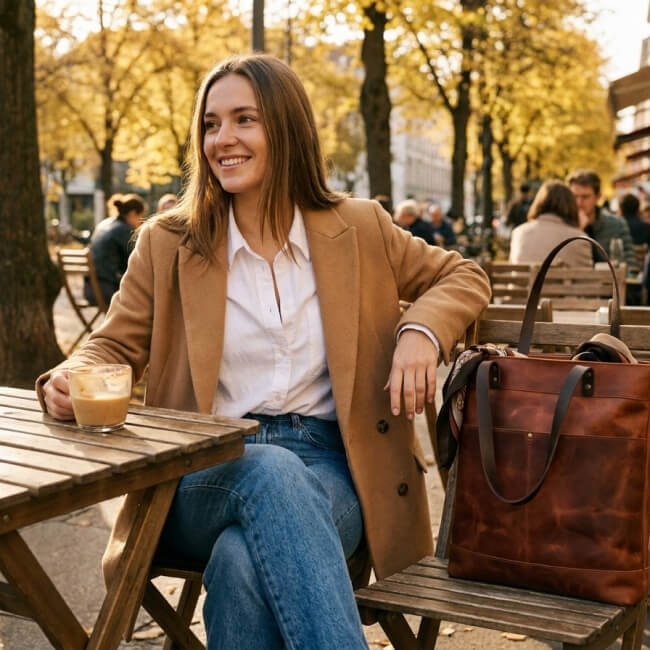 Her day doesn't follow a clean arc from home to office to home again. It splinters. There's a meeting at nine, then a lunch that runs long, then an errand she's been postponing for two weeks, and somewhere in there she is supposed to have replied to four emails. She dresses for the version of the day she intends to have and adjusts to the version she actually gets. Straight jeans and a good shirt under a lightly structured blazer. Loafers or ankle boots. Nothing that will look wrong in a professional setting or overdressed at a café table. This is the outfit of a woman who knows that most of what is called "smart casual" is just a code for not having to think twice.
A leather shopper bag in cognac brown is exactly the kind of thing she reaches for without deliberating. The Shopper Bag is built from Crazy Horse full-grain cowhide with vegetable-tanned straps — a combination that gives it structure without stiffness, and a surface that visibly improves with use rather than showing wear as damage. The cognac tone is warm without being loud, the kind of brown that photographs beautifully and disappears naturally into an autumn streetscape without trying to.
The reason this particular bag suits this particular look comes down to proportion and posture. A shopper bag, by its nature, sits differently from a tote or a crossbody: it hangs close to the hip when carried by the handles, drapes naturally against the side of a blazer, and doesn't require adjustment every twenty minutes the way a strap-heavy bag tends to. For smart casual dressing, where the whole point is that the components seem to have chosen each other, a shopper bag that simply settles into place is the right call.
What sets the shopper bag apart for this look specifically is its backpack conversion option. The adjustable vegetable-tanned strap, worn with the bag's built-in hardware configuration, transforms it into a low-profile leather backpack — one that does not announce itself as such, but simply shifts the carry mode when the day calls for free hands. This matters for a woman whose day has multiple registers: carrying a shopper into a meeting is one thing; cycling or walking fast between appointments with the same bag on her back, hands free, is another. One bag doing both without compromising how either version looks is genuinely useful, not just a marketed feature.
Full-grain leather also handles the tempo of a smart casual life well. It doesn't need to be protected from a light rain or kept away from café tables. It can be set down on a floor, tucked under an arm in a crowded tram, and retrieved without ceremony. The surface accumulates the faint impressions of daily contact — a slight darkening at the handle base, a softening of the fold at the top opening — and all of it reads as character rather than damage. For a woman who is always moving and rarely slowing down, a handmade leather shopper bag that keeps pace without requiring care is not a luxury. It's a practical decision that also happens to look exactly right.
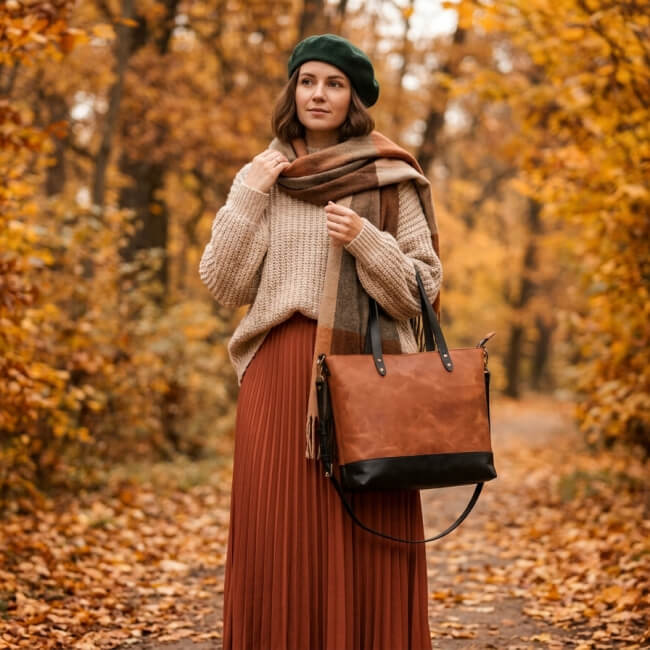 She doesn't dress to a system. The long pleated skirt in terracotta came from a market stall three years ago; the oversized knit in warm oat was a deliberate purchase in January, chosen because she knew she would wear it until March and probably again in September. The wide wool scarf was her grandmother's, or close enough. The beret she bought because she wanted a beret, which is reason enough. The whole thing is layered and textured and slightly old-fashioned in the best sense — it looks assembled by a person with actual preferences, not curated into coherence by a mood board. She is not an aesthete. She just notices things.
An outfit this rich in texture and warm tone needs a bag that can hold its own without competing. The Tote Bag does this with a simple formal decision: its cognac brown body meets a black detail treatment in a color-block composition that gives the bag a visual weight and clarity unusual for leather goods in this price range. The contrast is deliberate without being aggressive. Against a palette of terracotta, oat, and forest green, the cognac-and-black reads as an anchor — a piece that pulls the look toward something more finished without imposing a different aesthetic onto it.
The leather itself has a brushed, tonal quality that gives the surface a slightly matte depth — different from the gloss of patent leather or the sheen of heavily conditioned hides. Beside chunky knitwear and woven wool, this texture makes sense. It doesn't sit at odds with the softness of the layers around it; it complements them by being a different kind of tactile richness, firm where the knit is loose, smooth where the scarf is woven.
For a woman who dresses by accumulation and texture, a bag's relationship to the rest of the outfit is partly about how it looks and partly about how it behaves over time. The Tote Bag is available in three sizes, and the medium is the right call for a layered autumn look: large enough to accommodate a folded scarf, a book, and a small thermos, but proportioned so it doesn't overwhelm the silhouette of a long skirt and a generous knit. Carried by the handles at the elbow, it sits with a slight natural lean that suits the ease of this kind of dressing. Carried on a shoulder strap — an optional addition — it becomes slightly more practical for longer walks.
The color-block design also ages interestingly. As the cognac leather develops a patina and deepens at the edges, the contrast with the black sections shifts subtly over months of use — not dramatically, but noticeably, in the way that distinguishes something that has been lived with from something that is brand new. For a woman whose wardrobe already contains things she has carried and worn long enough to love, that kind of material evolution is not a liability. It is exactly what she was hoping for when she bought the bag in the first place.
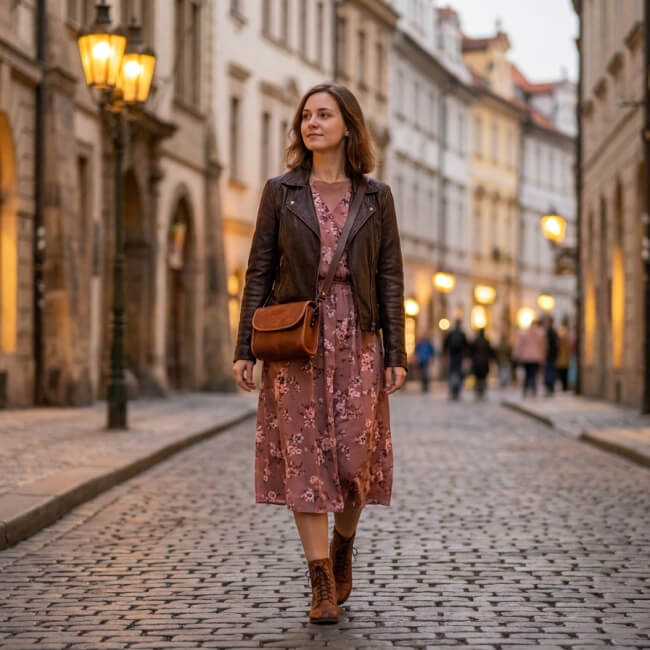 She is wearing a midi dress in dusty rose or dark sage — something she bought for summer and has refused to put away because it works just as well under a fitted brown leather jacket, which she throws on at 6pm when the temperature drops. The ankle boots have a slight heel and slightly too many buckles, which is exactly why she bought them. The cardigan she was wearing earlier is now in her bag. This is how she operates: light, adaptable, always a little underdressed for formal and always slightly too put-together for casual, landing in that zone where people can't quite decide if she is on her way to dinner or just back from a good walk. She is usually both.
A small cognac brown leather crossbody is the only bag that makes sense for this particular way of moving through a day. The Crossbody Bag is compact — 22 by 18 centimetres — which sounds restrictive until you consider what it is actually competing with: the alternative is a larger bag that requires a hand to carry it, or a small clutch that requires leaving the cardigan somewhere. The Crossbody Bag carries what it needs to carry, sits flat against the body, and asks nothing of the person wearing it. For an evening that started at 6 and is running toward 11, that kind of unobtrusiveness is exactly the point.
The flap closure with a magnetic snap means the bag opens in a single motion and closes just as fast — no searching for a zipper pull in a dark restaurant, no fumbling with a buckle while standing on a pavement. The adjustable vegetable-tanned strap runs long enough to wear across the chest or short enough to sit at the shoulder, depending on the jacket and the moment. This adjustability matters more than it sounds: a bag that shifts naturally between a daytime shoulder carry and an evening crossbody, without being swapped out or restructured, is a bag that disappears into the outfit rather than directing it.
Cognac brown full-grain cowhide in this format is one of the more reliable leather colours for feminine street dressing, because it reads differently depending on what surrounds it. Against dusty rose, it is warm and almost vintage. Against dark sage, it is grounded and earthy. Against black, it is a deliberate contrast. This chromatic flexibility is not accidental — it is what happens when a warm, mid-tone leather is given a clean silhouette and left alone. The antique-toned hardware completes the effect: brass-adjacent without being gold, aged without being worn.
The Kruk Garage notation on this bag is worth repeating: long-term use will produce a deeper tone in the leather. That is true of all full-grain hides, but the compact format of a crossbody means the wear patterns are especially concentrated and legible — the flap edge, the strap attachment points, the body corners. On a bag this size, those marks become a kind of miniature portrait of the person who carried it. For a woman who dresses with personality and keeps things she likes, that's a feature, not a footnote. Free personalisation — up to 12 stamped characters — is available on this bag at no extra cost, which turns it from a good purchase into a specific one.
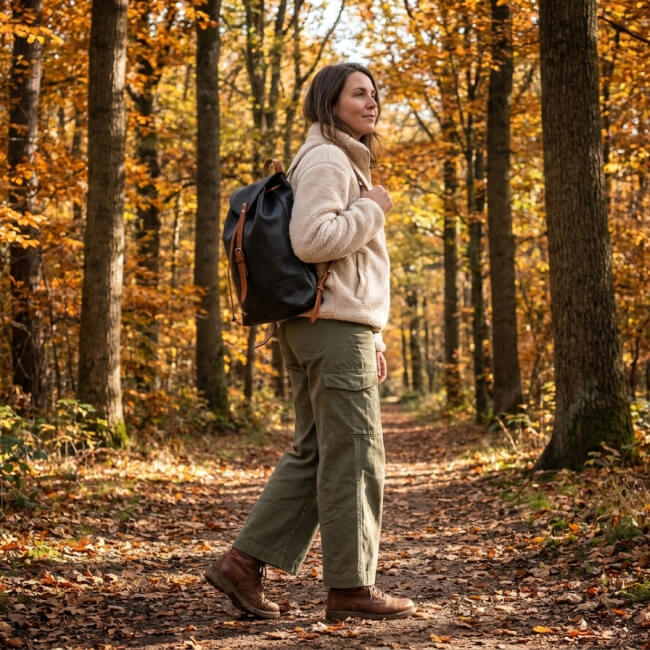 She leaves the house at eight and does not come back until five, and in between she will have walked several kilometres, sat in at least one coffee shop, picked up groceries on the way home, and probably stopped somewhere she didn't plan to. The olive cargo trousers are worn in the way that only comes from having been worn many times — the fabric is softer at the knee and the thigh, the colour slightly uneven in the good way. The cream fleece jacket is enormous and she does not apologise for it. The brown leather hiking boots have been resoled once. She knows exactly who she is and what she needs from a day outdoors: enough freedom of movement to not think about it, and enough to carry that she doesn't have to double back.
A leather backpack is the obvious answer for this look, which is exactly why the obvious answer has to be the right one. The Leaf Backpack is made from top-grain leather in black, with vegetable-tanned tan straps — a contrast that gives it a collegiate, slightly worn-in quality that reads as considered rather than sporty. It is not a hiking pack. It is not a day pack in the technical-gear sense. It is a leather backpack built to be carried on a person who also happens to be going somewhere active, and that distinction is visible in its proportions and finish.
The drawstring opening with a flap closure secured by a leather buckle-and-strap gives the Leaf Backpack a silhouette unlike a conventional zipped pack. It has a slightly sculptural quality when full — the drawstring gathers at the top, the flap falls naturally over the front — that pairs better with wide-leg trousers and a fleece than a stiff rectangular daypack would. Two YKK zipper pockets on the reverse side provide fast-access security for a phone, keys, or cards, without requiring the main compartment to be opened and rearranged in a moment of inconvenience. A small interior leather pocket keeps a phone separate from everything else.
For this particular kind of day — long, unplanned, physically active — the backpack format matters because it distributes weight without requiring a hand. Groceries, a water bottle, a spare layer, a book: these things can all be carried in the Leaf Backpack without the bag losing its posture. The adjustable vegetable-tanned shoulder straps are built for actual daily use, not decorative carry, and the removable handle strap at the top doubles as a keychain or a short-carry grip when the bag is coming off the back and going into a café.
The leather itself is worth noting for this use case. Top-grain cowhide in black with tan straps is about as durable a combination as a handmade leather bag can offer — black hides tend to be more forgiving of scuffs and contact marks than lighter tones, and the contrast tan straps will deepen and soften over time in a way that makes the bag look more specific to its owner rather than less. For a woman who uses her things hard and expects them to hold up, a women's leather backpack in this configuration is the slow fashion argument made physical: buy once, carry for years, and watch it get better in the process. The Leaf Backpack is not precious about being rained on, set on café floors, or stuffed under a market stall table. It is built for the kind of day she is actually having, not the kind of day a bag advertisement imagines she's having.
What connects these five women is not a shared aesthetic — it's a shared approach to owning things. They choose deliberately and keep what they choose. They don't replace bags seasonally. They notice when something they use every day has started to look better than it did when they bought it, and they value that more than they value novelty. A handmade leather bag from Kruk Garage is built for exactly that relationship: not to impress on arrival, but to become quietly indispensable over the months that follow.
Every piece in the Kruk Garage catalogue can be personalised at no extra cost — a name, initials, or a short text stamped directly into the leather before it leaves the workshop. It is a small thing and also not a small thing: a bag stamped with someone's name is no longer a bag anyone else owns. That specificity, combined with full-grain leather that develops its own surface record over time, produces objects that are genuinely singular. The full range is at krukgarage.com/catalogue.
The Halloween prep is ON. Door creaks... Footsteps approach... SCREA- Jokes, it’s only us coming thru with a hassle-free Halloween.

That’s right, there's biggest savings on your favorite comfy backpacks, stylish bags and exclusive professional accessories!

BIG news! KrukGarage has come with a massive drop of rolls *screams* They could be an amazing gift either for yourself or people you love.
You have successfully activated the promo code and now you can use it
This promo code is expired :(
But we can give you discount for 10%
Just enter
KRUKGARAGE10
in the promo code field.
Get the promo code to your email
Sign up for our newsletter and remain aware
of the latest updates and new in-stock items


