
Spooky season is here: 40% off everything
The Halloween prep is ON. Door creaks... Footsteps approach... SCREA- Jokes, it’s only us coming thru with a hassle-free Halloween.
Kruk Garage Handcrafted Atelier

There is a quiet test that every object either passes or fails over time. Not the test of first impressions — leather always wins that one — but the deeper test of sustained usefulness. Whether the thing earns its place. Whether it travels without complaint. Whether it becomes part of how you move through the world, rather than a burden you manage around.
The Roll Top Backpack by Kruk Garage passes that test. Not in theory, not on a mood board, but in practice — on bicycles and cobblestones, in gallery corridors and farmers' market crowds, under the weight of a mirrorless camera body and a weekend's worth of clothes packed with ruthless efficiency. It is a bag made by hand in a workshop in Ukraine, cut from thick crazy-horse cowhide, stitched with the same methods that have made leather goods last for generations. The WW2-era brass buckle at the roll top isn't decorative nostalgia. It closes. It holds. It will still close and hold in fifteen years.
This article is not a product review. It is a portrait of a bag lived in — six scenes, six different kinds of people and days, all anchored by the same object. The bag doesn't change between them. The person wearing it does. That, finally, is the point.
The 48-hour trip is its own discipline. Packing for it means choosing with precision — not minimalism for its own sake, but the satisfaction of needing nothing you don't have and carrying nothing you won't use. For a weekend escape, the Roll Top Backpack is not a compromise. It is the right tool.
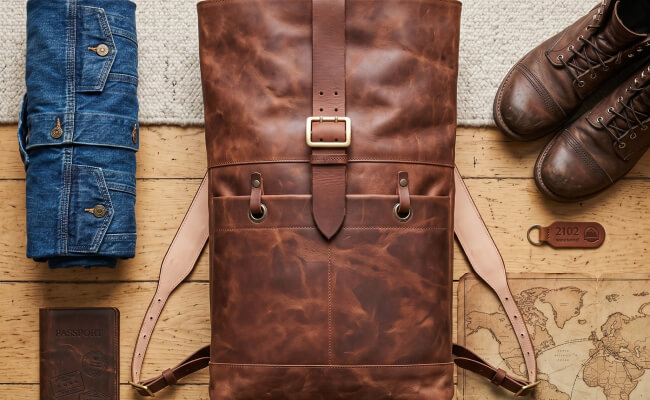 The roomy single-compartment interior, lined in two-toned Italian denim, accommodates more than the bag's silhouette suggests. Rolled tightly — 44 cm in collapsed height — the backpack reads as a day bag on city streets. But unroll it to its full 57 cm and suddenly there is space for a change of clothes, a toiletry pouch, a paperback, and whatever you'd bring for a slow Saturday in an unfamiliar town. The two front zip pockets handle the things you reach for constantly: a passport, a boarding pass, a folded map.
What matters most in transit is not the bag's capacity but its composure. Leather does not slump. It holds its structure at the overhead bin, at the café chair, on the train rack. The brass hardware doesn't snag on anything; the buckle closes with a satisfying click that feels final in the best possible way. Slow travel has an aesthetic — worn leather, brass details, a bag that could have arrived on this train in 1968 as easily as today — and this backpack is entirely at home within it. You will be asked where it came from. Have an answer ready.
What fits comfortably: one day's change of clothes, a compact toiletry bag, a 13-inch laptop, a phone charger, a journal, and a bottle of wine for the host — with room to spare.
There is a contradiction at the heart of every creative who works on location. The tools that make the work possible are heavy, awkward, and expensive. The bag that carries them should feel like it belongs to the work — not like equipment management. Most camera bags fail this test immediately. They look like camera bags. They announce their contents. They are built for a single job and do it without grace.
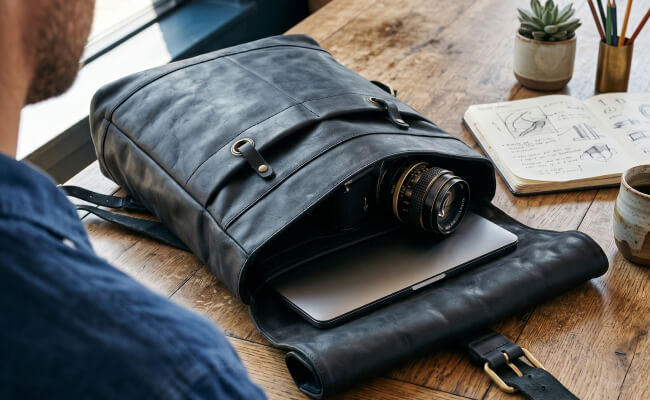 The Roll Top Backpack handles photographic gear with a different logic. The main compartment fits a mirrorless or DSLR body with a mounted 50mm lens laid flat, two additional lenses wrapped in lens pouches, a thin laptop for tethered shooting or post-processing on the road, and a compact LED panel — all without padding inserts, all padded by the natural density of leather that softens impact without trapping it. The front zip pockets are ideal for memory cards, a battery bank, and a lens cleaning kit.
For illustrators, jewellery-makers, and other travelling craftspeople, the logic is the same. A craft object carries craft tools honestly. There is no irony in arriving at a market stall or a workshop residency with a handmade leather bag — it is a statement of values before you say a word. The bag communicates that the things inside it were chosen, not grabbed.
One practical note: the roll-top closure expands the opening to nearly the full width of the bag, which means getting a camera in and out is a single, un-fussy motion. There is no wrestling with a zipper. There is no partial closure that makes you anxious about the contents. Open, retrieve, close — the buckle takes three seconds. In the field, those three seconds matter.
The tyranny of the work bag is that it forces a choice: carry something appropriate for the office, or carry something you actually want to be seen with in the evening. Most bags resolve this poorly, erring toward the professional and abandoning any claim to personal style once the day ends. The result is that people carry two bags, which is a very reasonable response to a poorly designed object.
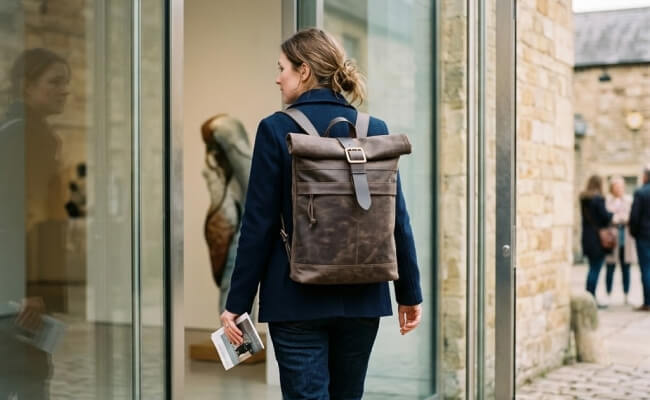 The Roll Top Backpack dissolves this tension. Its silhouette is formal enough for a studio, an agency, or a client meeting — the structured leather, the clean lines of the roll-top closure, the understated brass hardware — without being corporate. It does not read as a tech commuter bag or an outdoor gear piece. It reads as something that was made for a person, by a person.
Wardrobe pairings that work:
Inside, the single main compartment carries a 13-inch laptop, a notebook, a charger, and a lunch container — the entire functional load of a working day. The front pockets handle the smaller items that a professional reaches for without ceremony: keys, cards, a folded invoice. When five o'clock comes, nothing needs to be repacked. You leave as you arrived, which is the only kind of transition worth making.
There is a particular pleasure in carrying good things in a good bag. The Saturday morning market trip is one of the few domestic errands that has retained its ritual quality — the arrangement of stalls, the unhurried pace, the accumulation of things that are well-made and honestly priced. Bringing a handmade leather bag to a farmers' market is not an affectation. It is a coherent position: if you care about how food is grown and made, it follows that you might care about how the things you carry are made.
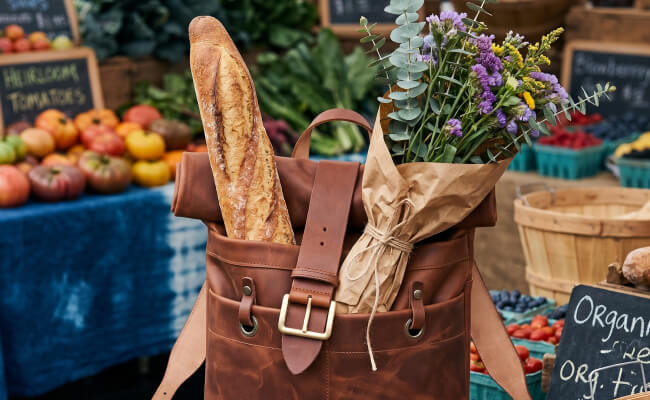 The roll-top design is genuinely practical for market use in a way that conventional backpacks are not. It opens wide and closes wide, which means a baguette, a bunch of sunflowers, a bottle of cold-pressed olive oil, and a wrapped wheel of cheese can all go in together without the lateral compression of a zip closure. The leather handles at the top — sturdy, hand-stitched, comfortably wide — mean the bag can be carried by hand when the shoulder straps feel like too much formality for a sunny square.
There is also the matter of accumulation with dignity. A canvas tote surrenders its shape under the weight of a Saturday haul. A synthetic backpack wears its abundance awkwardly. Full leather keeps its form. The bag looks as considered with a baguette sticking out the top as it does empty on a coat hook — which is a quality that almost nothing else shares.
For the slow-living household, this is not a bag reserved for special occasions. It is the bag that gets used most, precisely because its design is honest about multiple uses at once.
The outdoor equipment industry has spent decades convincing hikers that synthetic materials are the only serious choice for anything involving weather, elevation, or exertion. The argument is not entirely wrong: for ultralight through-hiking in alpine conditions, a technical pack serves purposes that leather cannot. But for heritage hiking — day walks through misty coastal paths, forest trails, long hill days with a thermos and a camera — the leather roll-top belongs in an entirely different conversation.
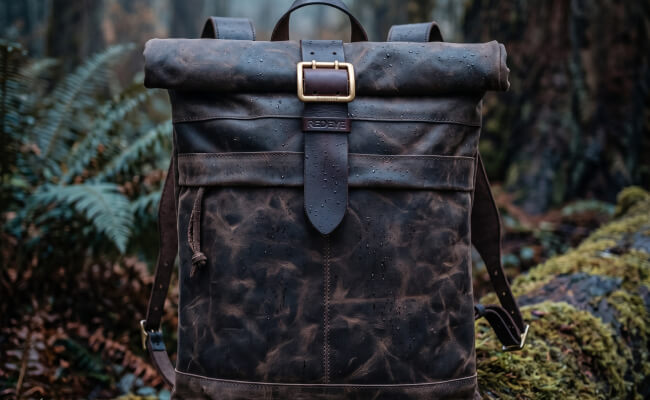 Crazy-horse cowhide, the material used for this backpack, is one of the more water-resistant leathers available without added synthetic coatings. It is treated with wax and tallows during processing, which gives it a natural resistance to moisture, a resistance that increases with age and conditioning rather than degrading as nylon eventually does. Rain falls on it, dries, and leaves behind a slightly darkened patina that becomes part of the bag's character. The brass hardware will develop a warm tarnish. The leather will crease and mark in ways that record the terrain it has crossed.
This is the central argument for leather in outdoor contexts: patina as proof of use. A synthetic bag looks worse after ten years. A well-maintained leather bag looks better. The marks it accumulates are not damage — they are evidence. An outdoors person who understands this carries their leather bag on trail the same way they might carry a good wool jacket: with the confidence that comes from choosing something built to last.
Leather care for trail use:
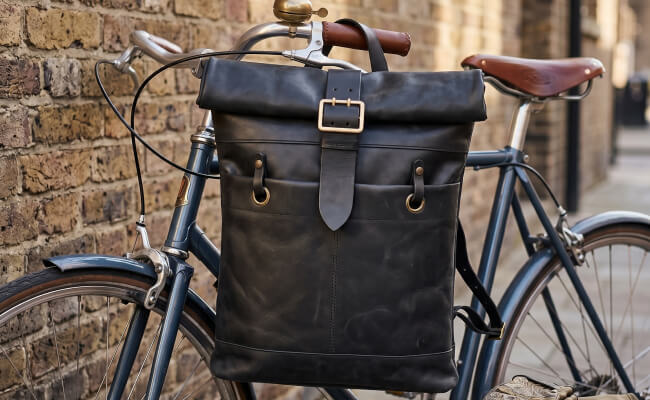 Urban cycling has an aesthetic problem. The functional gear — hi-viz vests, messenger bags with reflective panels, panniers built for practicality above everything else — is designed by engineers for safety and load capacity. These are not wrong priorities. But the result is that a cyclist who cares about how they look arriving at a meeting, a studio, or a dinner is forced to manage a constant tension between the practicalities of the ride and the expectations of the destination.
The leather roll-top backpack resolves this without compromise. Its back panel, sitting flat against the spine, distributes the weight evenly across the shoulders in a way that prevents the lateral swinging that plagues heavier bags on a bike. The roll-top closure is genuinely more secure than a zipper in cycling conditions — it creates a sealed tube at the top of the bag that resists the subtle vibration and movement of city riding. Nothing shifts. Nothing opens without deliberate action.
On a classic steel frame bicycle — the kind with leather saddle and brass bell that this bag was practically made to accompany — the combination has a coherence that turns heads for the right reasons. But it works equally well on a modern commuter bike or an e-cargo. The bag doesn't require a curated aesthetic to function. It simply looks right because leather on a bicycle is one of those combinations that has looked right for over a century.
Practical notes for cyclists:
What connects all six of these scenes is not a style or a lifestyle category. It is a simpler idea: a well-made object earns its place not by specialisation, but by honesty. The Roll Top Backpack by Kruk Garage is honest about what it is. The leather will mark. The brass will tarnish. The stitching will settle into the creases of regular use. None of this is deterioration. It is the bag becoming more itself over time — and, in the process, becoming more yours.
The bag doesn't change between scenes. It doesn't need to. A thing built with this kind of care contains its own versatility. The person carrying it brings the context; the bag brings the rest.
Handmade in Ukraine by the craftspeople at Kruk Garage. Available in several leather finishes, each with its own character and its own way of ageing. Explore the full collection of the Roll Top Backpack at krukgarage.com.
— Kruk Garage Handcrafted Atelier —
The Halloween prep is ON. Door creaks... Footsteps approach... SCREA- Jokes, it’s only us coming thru with a hassle-free Halloween.

That’s right, there's biggest savings on your favorite comfy backpacks, stylish bags and exclusive professional accessories!

BIG news! KrukGarage has come with a massive drop of rolls *screams* They could be an amazing gift either for yourself or people you love.
You have successfully activated the promo code and now you can use it
This promo code is expired :(
But we can give you discount for 10%
Just enter
KRUKGARAGE10
in the promo code field.
Get the promo code to your email
Sign up for our newsletter and remain aware
of the latest updates and new in-stock items


